What a training centre provides
Specialist supervision
Direct supervision, regular feedback and structured progress reviews support each resident’s development throughout their training.
Clinical experience
A sufficient and varied caseload provides opportunities to develop the required skills, with externships supporting experience in additional cases and techniques.
Facilities and learning resources
Clinical and laboratory facilities, appropriate equipment and access to scientific literature support practical training and evidence-based care.
Fields of training
Centres may be approved to provide training in one or more of the following fields.
- Small animal reproduction
- Equine reproduction
- Ruminant reproduction and herd health
- Porcine reproduction and herd health
- Reproductive biotechnology
Requirements and approval
Detailed training centre requirements
Supervision and progress review
Residents must receive direct supervision from an ECAR Diplomate or an approved equivalent. The supervisor oversees progress, holds monthly review meetings and submits annual progress reports.
One supervisor may train up to three residents, or their part-time equivalents.
Clinical caseload
Centres must provide sufficient case numbers and variety to cover the species and procedures required by the training programme. Where particular cases or techniques are unavailable, externships at other approved institutions are encouraged.
Clinical and laboratory facilities
Required facilities and equipment include:
- Clinical examination rooms.
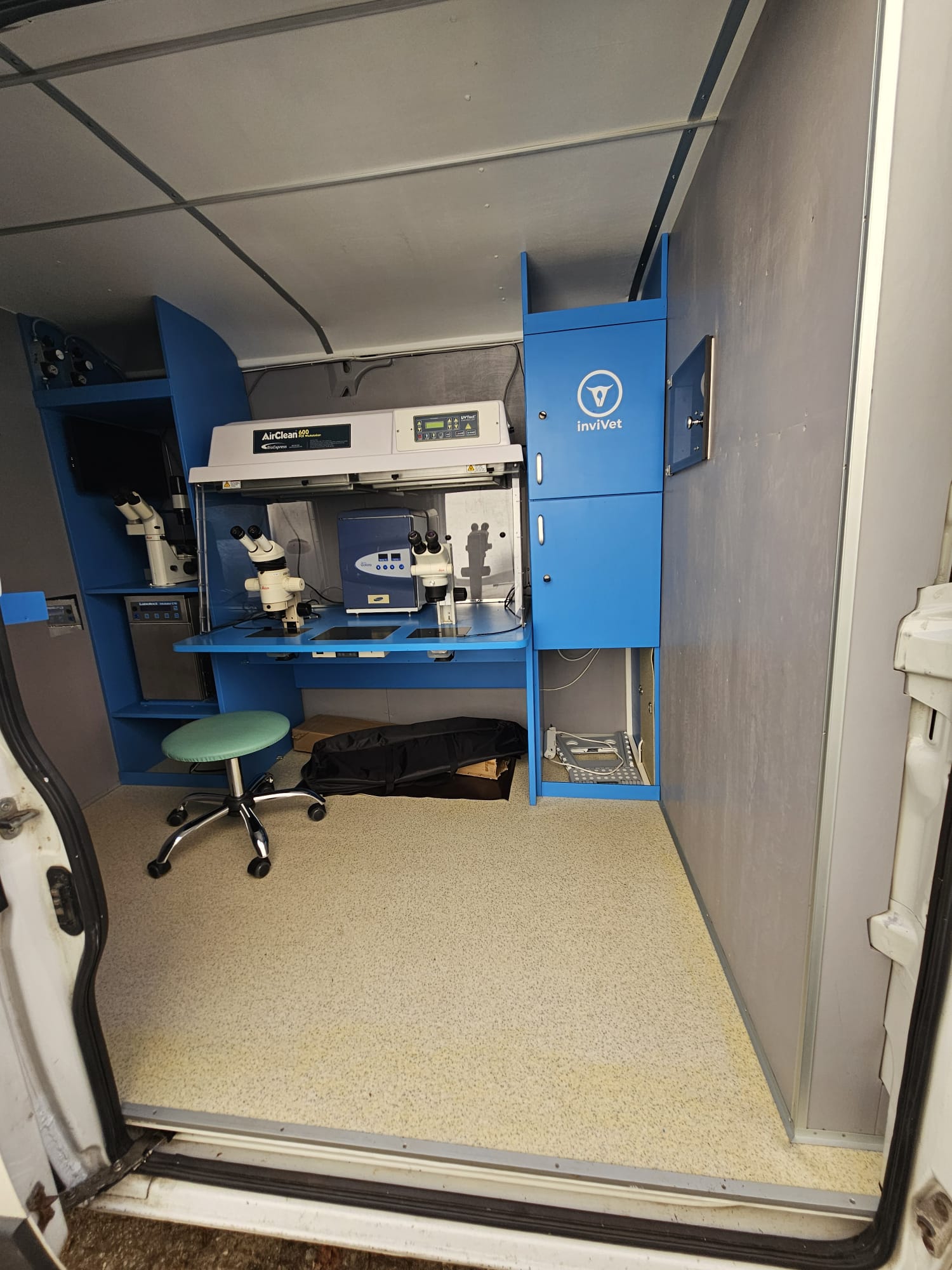
- Transrectal and transabdominal ultrasound equipment.
- Semen collection and reproductive surgery rooms.
- Laboratory facilities for gamete analysis and biotechnology.
- Facilities for reproductive endocrinology and embryo transfer techniques.
Academic resources
Residents must have access to a scientific library containing current veterinary and life science books and journals, including English-language materials, together with internet access.
Applying for ECAR approval
Training centres apply for approval by the ECAR Board. The Education and Residency Committee defines the criteria and monitors compliance.
- Document the proposed training provision. Describe the facilities, equipment, clinical caseload, staffing, supervision arrangements and training plan.
- Submit the centre for evaluation. Provide the information needed for ECAR to assess the proposed training and available resources.
- Receive the Board’s decision. Approval is granted by the ECAR Board following evaluation against the training requirements.
Approved centres are subject to periodic review and recertification.
Maintaining approval and reporting changes
Maintain the training environment
Centres must continue to meet ECAR’s requirements for supervision, clinical experience, facilities and educational resources.
Report significant changes immediately
Notify ECAR of changes that could affect training, including a change or absence of the supervisor, reduced clinical caseload, or loss of essential equipment.
Review before reactivation
A programme that has been inactive for more than 24 months must be reviewed before it restarts.
Failure to maintain the required standards may result in probation or withdrawal of approval.
Training programmes
| Training centre | Details | Program Director |
|---|---|---|
| AniRepro-Reims Reims, France |
Standard programme Duration: 4 years Next accreditation: 2028 |
Dr. Emmanuel TOPIE 1 resident |
| Departement of Veterinary Science University of Pisa Pisa, Italy |
Standard programme Duration: 4 years Next accreditation: 2026 |
No director recorded 6 residents |
| Departemento Mediche Veterinarie Universita di Bologna Bologna, Italy |
Standard programme Duration: 4 years Next accreditation: 2026 |
Dr. Daniele Zambelli 5 residents |
| Department of Veterinary Medicine and Animal Science Universita di Milano Milan, Italy |
Standard programme Duration: 4 years Next accreditation: 2026 |
Prof. Gaia Cecilia Luvoni 3 residents |
| Dipartimento di Medicina Animale University di Padova Padova, Italy |
Standard programme Duration: 4 years Next accreditation: 2026 |
Prof. Stefano Romagnoli 4 residents |
| École Nationale Vétérinaire d'Alfort Paris, France |
Standard programme Duration: 4 years Next accreditation: 2026 |
Prof. Alain FONTBONNE 1 resident |
| École Nationale Vétérinaire Toulouse Toulouse, France |
Standard programme Duration: 4 years Next accreditation: 2026 |
Prof. Sylvie CHASTANT 1 resident |
| Facultad de Veterinaria Universidad de Murcia Murcia, Spain |
Standard programme Duration: 4 years Next accreditation: 2026 |
Juan Maria Vazquez 1 resident |
| Facultat de Veterinària-UAB Barcelona, Spain |
Standard programme Duration: 4 years Next accreditation: 2026 |
No director recorded 1 resident |
| Farm Animal Clinic, Vetsuisse Faculty, University of Bern Bern, Switzerland |
Standard programme Duration: 4 years Next accreditation: 2026 |
Prof. Gaby HIRSBRUNNER 1 resident |
| Ghent University Department of Obstetrics, Reproduction and Herd Health Ghent, Belgium |
Standard programme Duration: 4 years Next accreditation: 2026 |
Prof. Ann Van Soom 6 residents |
| Justus-Liebig University Giessen Giessen, Germany |
Standard programme Duration: 4 years Next accreditation: 2026 |
Prof. Axel Wehrend 2 residents |
| Liège Univeristé Clinique Vétérinaire Liège, Belgium |
Standard programme Duration: 4 years Next accreditation: 2026 |
Prof. Stefan DELEUZE 3 residents |
| Ludwig-Maximilian-Universitiy Munich Munich, Germany |
Standard programme Duration: 4 years Next accreditation: 2026 |
Holm Zerbe 5 residents |
| Medicina Veteriaria Universita di Torino Torino, Italy |
Standard programme Duration: 4 years Next accreditation: 2026 |
Prof. Ada Rota 3 residents |
| National Veterinary School of Nantes Nantes, France |
Standard programme Duration: 4 years Next accreditation: 2026 |
No director recorded 3 residents |
| Nicolaus Copernicus University Faculty of Biological and Veterinary Sciences Torún, Poland |
Standard programme Duration: 4 years Next accreditation: 2027 |
Prof. Pawel KORDOWITZKI 3 residents |
| Norwegian University of Life Sciences-Oslo Oslo, Norway |
Standard programme Duration: 4 years Next accreditation: 2025 |
Dr. Adam Dunstan Martin 3 residents |
| Swedish University of Argicultural Science-Uppsala Uppsala, Sweden |
Standard programme Duration: 4 years Next accreditation: 2026 |
Prof. Renée Båge 7 residents |
| Therio VT Care , Rixensart, Belgium Rixensart, Belgium |
Standard programme Duration: 4 years Next accreditation: 2026 |
Dr. Giovanna Bassu 1 resident |
| Tierärztliche Hochschule Hannover Hannover, Germany |
Standard programme Duration: 4 years Next accreditation: 2026 |
Prof. Sandra Goericke-Pesch 3 residents |
| Tierarztpraxis Schönow Berlin, Germany |
Standard programme Duration: 4 years Next accreditation: 2026 |
Dr. Andrea Münnich 2 residents |
| Tyrus Veterinary Clinic-AniCUra Terni Terni, Italy |
Standard programme Duration: 4 years Next accreditation: 2026 |
Dr. Riccardo Orlandi 1 resident |
| UC Davis California, United States |
Standard programme Duration: 4 years Next accreditation: 2026 |
Dr. Pouya Dini 2 residents |
| Université Lyon, VetAgro Sup Lyon, France |
Standard programme Duration: 4 years Next accreditation: 2026 |
Prof. Samuel Buff 2 residents |
| Universitiy of Evora Evora, Portugal |
Standard programme Duration: 4 years Next accreditation: 2026 |
Dr. Tiago Pessanha Guimaraes 1 resident |
| Universitiy of Liverpool Liverpool, United Kingdom |
Standard programme Duration: 4 years Next accreditation: 2026 |
Prof. Robert Frank Smith 1 resident |
| Universitiy of Veterinary Medicine Budapest Budapest, Hungary |
Standard programme Duration: 4 years Next accreditation: 2026 |
Prof. Sandor Cseh 1 resident |
| University College Dublin, School of Veterinary Medicine Dublin, Ireland |
Standard programme Duration: 4 years Next accreditation: 2026 |
Dr. Marijke Beltman 3 residents |
| University of Helsinki, Faculty of Veterinary Medicine Helsinki, Finland |
Standard programme Duration: 4 years Next accreditation: 2026 |
Prof. Olli PELTONIEMI 5 residents |
| University of Illinois Illinois, United States |
Standard programme Duration: 4 years Next accreditation: 2026 |
Dr. Igor Canisso 1 resident |
| Utrecht University Utrecht, Netherlands |
Standard programme Duration: 4 years Next accreditation: 2026 |
Dr. Tom Arjun Edgar Stout 3 residents |
| Veterinary Reproduction Service, Cambridge, England Cambridge, United Kingdom |
Standard programme Duration: 4 years Next accreditation: 2026 |
Dr. Angelika von Heimendahl 1 resident |
| Vetmeduni Vienna Vienna, Austria |
Standard programme Duration: 4 years Next accreditation: 2026 |
Prof. Christine Aurich 6 residents |
| Vetsuisse Faculty Zürich Zürich, Switzerland |
Standard programme Duration: 4 years Next accreditation: 2026 |
Dr. Doreen Zoller 7 residents |